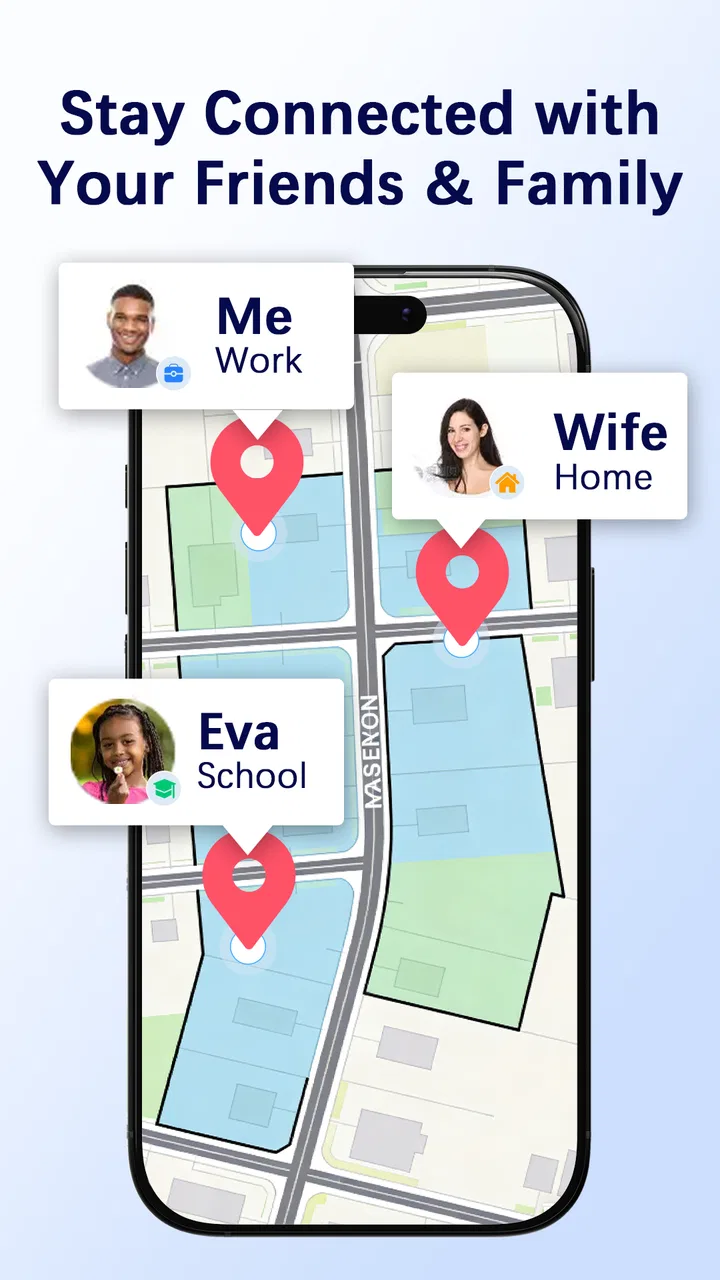
Phone Tracker GPS Location
- 3.9
- Rating
- 1.00M
- Installs
- Free
- Price

 Analysis by App-foxy
Phone Tracker GPS Location is the kind of app I would install during a worried moment: a family member is late, someone is travelling, or I simply want an easier way to check where a loved one is. Its purpose is clear, and the first impression is built around reassurance rather than entertainment. In my experience, that makes it easy to understand quickly, but it also raises an important question: does a location tool remain useful after the original concern has passed?
This free Maps & Navigation app is developed by Esame Marketing Limited and is aimed at an Everyone audience. It has passed the curiosity stage with over a million installs, while its average rating sits at 3.9 from around two and a half thousand ratings. Those figures suggest a product that attracts plenty of attention but does not satisfy every user equally. I found that fair: a phone tracker can be genuinely helpful, yet its value depends heavily on cooperation, routine, battery habits, and whether everyone involved is comfortable using it.
What the first week feels like
The first week is where Phone Tracker GPS Location makes its strongest case. A family location app has an immediate emotional benefit because it turns “Where are they?” from a message that may go unanswered into something you can check through a map-based tool. That does not remove every worry, but it can reduce unnecessary calls and give a household a shared point of reference.
You May Also Like

 Blood Strike: 2.5 Anniversary
Blood Strike’s Loadouts Turn Every Drop Into a Tactical Gamble
A close look at Blood Strike’s custom loadouts: how fast access to signature weapons reshapes its battle royale rhythm, rewards preparation, and narrows the gap between fights.

 Pandora - Music & Podcasts
Pandora’s Music Is Easy to Start, but Harder to Recover
Pandora’s strength is its low-effort path from a seed to a station. Its weak spot is how much confidence it asks you to place in connection, setup, and quiet recovery.

 8 Ball Pool
 Is Built on Rivalries, Rematches, and Routine
A close look at the rivalries, rematches, shared routines, and unanswered safety questions that turn a quick pool match into a persistent mobile community.

 Samsung Music
’s Quiet Strength Is Playing What You Already Own
Its reach comes less from spectacle than from dependable access to a personal library. That simplicity is both the app’s strongest retention engine and its ceiling.

 AccuWeather: Weather Radar
AccuWeather Review: A Quick, Clear Forecast for Everyday Decisions
For everyday plans, the best forecast is the one you can understand quickly. AccuWeather makes rain timing, radar, and local conditions easy to act on, with a few trade-offs.

 Hill Climb Racing
Why Hill Climb Racing Still Turns Crashes Into One More Run
A tiny car, a bumpy hill and one more upgrade: Hill Climb Racing keeps resurfacing because its simple chaos makes every near-miss feel personal.
More From Our News Desk



I would introduce it carefully rather than installing it secretly. The most successful setup is one where every person understands why it is being used, what kind of reassurance it offers, and when checking a location is reasonable. That conversation matters more here than with an ordinary navigation app. A tracker is not just a map; it becomes part of the relationship between the people sharing their whereabouts.
The app’s store summary focuses on locating family and a partner around the clock, so its natural audience is clear. It is better suited to a small circle of people who already have a practical reason to stay connected than to someone looking for a general-purpose route planner. If your only goal is turn-by-turn driving directions, a conventional navigation service will usually be the better fit. This app is about knowing where someone is, not finding the fastest way to a destination.
During the early trial period, I would use it for a few specific routines instead of watching the map constantly. For example, a parent might check whether a teenager has arrived near school after an evening activity, or partners might use it while one person is travelling home late. A useful habit is to check at the moment information is needed, then close the app, rather than turning reassurance into continuous monitoring.
That approach also exposes the first practical trade-off. A location shown on a screen is only useful if the phone is with the person, has enough battery, can determine its position, and can communicate that position. The app may make checking easier, but it cannot turn a dead or misplaced phone into a reliable signal. I would treat its map as a helpful indication, not as proof that someone is safe or exactly where the marker appears.
The current version is 1.1.5, and the app supports Android 7.0 or later. That makes it accessible to people using older Android devices, which is useful in families where not everyone upgrades at the same time. Still, compatibility alone does not guarantee a smooth everyday experience. Older phones can have different battery-saving behavior, and location tools are especially sensitive to those background restrictions.
A realistic everyday routine
Imagine a household where one person finishes work late and usually sends a message before leaving. On a normal evening, the family may not need the tracker at all. On a rainy night, when the expected arrival time has passed and a message has not been answered, opening the app can provide a quick point of reference. If the person is moving along the expected route, the situation may feel less urgent; if the location appears unchanged for a long time, the family knows it should call rather than continue guessing.
That is the right scale of use for me. The app is most valuable as a backup to ordinary communication, not as a replacement for it. A location marker cannot explain why someone is delayed, whether they need help, or whether the phone has been left in another room. Using it alongside calls and messages keeps expectations realistic.
One non-obvious tip is to agree on a small number of moments when checking is useful. Without that agreement, a person may feel watched while another person feels ignored whenever the location is not refreshed quickly enough. A shared routine makes the tool less intrusive and reduces the temptation to interpret every movement as meaningful.
What remains useful after the novelty fades
After the first week, the excitement of seeing a family member appear on a map naturally weakens. That is not necessarily a problem. A good utility app should become ordinary. The real test is whether it continues to solve a recurring problem without demanding too much attention from everyone involved.
Phone Tracker GPS Location has lasting value when the same location-related uncertainty happens repeatedly. Families with changing schedules, partners who travel, and people who want a simple check-in option may find that it becomes part of their routine. In those cases, the app earns space because it answers a question that comes up again and again, not because the interface is novel.
Its value is weaker when the need is occasional and communication is already reliable. If everyone responds quickly to messages and shares plans clearly, opening a tracker may add little. I would not keep it installed merely because it once helped during a single anxious evening. The strongest long-term case is a continuing need, such as coordinating several people whose schedules rarely line up.
The free entry point helps with that decision because you can judge the basic experience before committing money. There are in-app purchases ranging from $2.99 to $9.99 per item, so I would avoid making a purchase during the initial emotional rush. First see whether the people who need to participate actually use it consistently. A paid option is only worthwhile if it supports a routine that has already proved useful.
That is another practical insight: the person who installs the app is not necessarily the person who determines whether it succeeds. A tracker depends on a group. If one family member refuses to keep the app available, disables the relevant access, leaves the phone behind, or simply forgets the agreed routine, the whole experience becomes less dependable. No single user can solve that social problem through the app alone.
I also think the app should be judged against simpler alternatives. A shared message saying “I’m leaving now” is faster and more personal when the situation is straightforward. A phone’s built-in location-sharing tools may be preferable for people who already use the same platform and want fewer separate apps. A full family-safety service may suit larger households that need more tools than location checking. Phone Tracker GPS Location makes most sense for someone who wants a focused phone-tracking experience rather than a broad digital family-management system.
When the app earns a permanent place
For long-term use, I would look for three signs. First, the app should answer a real question often enough to justify its presence. Second, the people being located should be comfortable with the arrangement. Third, checking should reduce stress rather than create a new source of it. If those three conditions are present, a location app can become quiet background support.
For example, a couple may use it during irregular work shifts without needing to send repeated updates. A family might use it around school pickups, long commutes, or travel days. Someone caring for an older relative could appreciate a shared location reference, provided the arrangement is openly discussed and does not replace direct contact. These are not reasons to monitor every minute; they are situations where a quick location check can prevent unnecessary uncertainty.
On the other hand, I would skip it if you want precise safety guarantees, detailed travel history, or a complete emergency-response system. The store summary presents it as a GPS locator, not as a substitute for emergency services or personal communication. I would also skip it if the people involved are uncomfortable with location sharing. A tool intended to create calm can have the opposite effect when trust and boundaries are not settled first.
Maintenance is the real cost
The ongoing burden of a tracker is less about opening it and more about keeping the surrounding habit healthy. Phones need to remain charged, people need to carry them, and everyone needs to understand what a stale or inaccurate-looking location might mean. That maintenance is easy to overlook because the app itself may appear simple.
I would make battery awareness part of the routine. Someone leaving for a long trip should charge the phone before departing, and a person who regularly forgets their device should not be treated as continuously trackable. This sounds obvious, but it is one of the biggest differences between a reassuring tool and a misleading one. The app can only work with the phone conditions available to it.
Another useful habit is to review the arrangement after a few weeks. Does everyone still need access? Are people checking too often? Is the app being used during the situations it was meant for, or has it become a way to settle ordinary disagreements? A short conversation can prevent the tracker from becoming an automatic source of suspicion.
I would also keep expectations simple. If a family member is at a familiar place, a location check may be enough. If the situation is urgent, call them and use normal safety procedures rather than relying on the map. This distinction is important because a map can look authoritative even when the underlying information is delayed, approximate, or connected to the wrong physical circumstance.
Because the app is free to install, the maintenance decision is mainly about attention and trust before it becomes about money. The purchase range matters only after the basic routine works. I would not pay to preserve a habit that nobody follows. Conversely, if the app has become a genuinely useful part of family coordination, the optional spending may feel more reasonable, as long as the cost matches what you actually need.
Small frictions that matter over time
The first source of fatigue is checking without a clear reason. A tracker can encourage repeated refreshing, especially when someone is late or not answering. That behavior rarely produces better information. I found it more sensible to define a response plan: check once, try to contact the person, and escalate appropriately if the circumstances justify it.
The second is ambiguity. A marker may tell you where a phone appears to be, but not why it is there. A person could be in a building, on a road, or somewhere nearby while the screen leaves you wanting more context. If you need detailed explanations, the app will not replace a conversation. Its strength is reducing uncertainty about broad whereabouts, not interpreting a person’s intentions.
The third is group participation. A tracker is only as dependable as the least consistent phone in the circle. If one device has a different battery routine or one person rarely opens the app, the household may start arguing about reliability. Before installing it for several people, I would test the routine with the one person most likely to be difficult to coordinate. That reveals more than a quick solo trial.
There is also a privacy trade-off that should be discussed plainly. Sharing a location can be comforting when voluntary and limited, but uncomfortable when it becomes an expectation. I would establish who can see the location, when checking is appropriate, and what happens if someone wants to pause the arrangement. Even without turning the conversation into a formal agreement, clear boundaries make long-term use much healthier.
People with older Android phones may appreciate the minimum operating-system requirement, but they should still pay attention to how their particular device manages background activity. If location updates feel inconsistent, the first response should be practical: check battery-saving behavior, confirm that the phone is being carried, and compare the result with a direct call. I would not assume that every irregular marker means the app itself is failing.
My long-term verdict
Phone Tracker GPS Location earns lasting space only when it becomes a calm, occasional aid rather than a source of constant supervision. I like the clarity of its purpose and the fact that it is free to try. The app is especially appealing for families or couples who regularly need a quick location reference and are willing to build a respectful routine around it.
My recommendation is more cautious for people who want an all-in-one safety platform, detailed navigation, or guaranteed real-time precision. In those cases, a built-in sharing feature, a conventional navigation app, or a broader family-safety product may be a better match. This app should be chosen for focused location awareness, not because the word “GPS” suggests it can solve every travel or emergency problem.
The 3.9 average rating reflects the mixed reality of this category: the idea is immediately useful, but the experience depends on phones, habits, and human cooperation. I would install it for a specific recurring need, test it without buying anything, and decide after the first few weeks whether it genuinely reduces unnecessary worry. If it does, keep the routine light and transparent. If it creates more checking, tension, or confusion than reassurance, uninstalling it is the sensible choice.
For me, the strongest reason to recommend Phone Tracker GPS Location is not the novelty of watching a map. It is the possibility of replacing repeated “Are you there yet?” messages with a simple, agreed-upon check. The strongest reason to hesitate is that the app cannot maintain trust or reliability on its own. Used as a backup to communication, it can be a practical family tool. Used as a substitute for communication, it is unlikely to deliver the lasting calm its purpose suggests.
FAQs for Phone Tracker GPS Location
01How accurate is the Phone Tracker GPS Location app?
The Phone Tracker GPS Location app is designed to provide highly accurate location tracking by using a combination of GPS, Wi-Fi, and cellular data. While the accuracy is generally within a few meters, it can vary depending on the device used and the surrounding environment, such as urban areas with tall buildings or rural areas with limited connectivity.
02Is Phone Tracker GPS Location safe to use?
Yes, the app is safe and prioritizes user privacy and data security. It employs encryption to protect your location data and requires user permissions for tracking. However, it’s important to ensure that you download the app from a reputable source and regularly update it to maintain security standards.
03Does Phone Tracker GPS Location work without an internet connection?
The app primarily relies on GPS, which does not require an internet connection. However, for real-time tracking and sharing location updates with others, an internet connection is necessary. Offline functionality may be limited to tracking your own location without sharing it.
04Can Phone Tracker GPS Location drain my phone’s battery quickly?
Continuous use of GPS and location services can indeed drain your phone’s battery faster than usual. The app is optimized to minimize battery usage, but it’s recommended to adjust the app’s settings to limit background activity or use power-saving modes when necessary.
05Is Phone Tracker GPS Location compatible with all devices?
Phone Tracker GPS Location is compatible with most Android and iOS devices. However, some older models may experience limitations in functionality due to outdated hardware or software. It is advisable to check the app’s compatibility with your device’s operating system version before downloading.
Pros
- Accurate real-time tracking for precise location updates.
- Simple interface makes navigation intuitive and easy.
- Low battery consumption during background operation.
- Works seamlessly across both Android and iOS devices.
- Customizable alerts for location changes.
Cons
- Requires constant internet for accurate data.
- Privacy concerns due to location sharing.
- Limited features in the free version.
- Can drain battery if used continuously.
- May have occasional GPS signal issues.

Phone Tracker GPS Location
Gallery